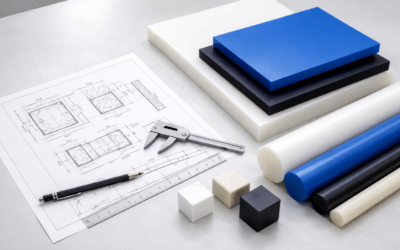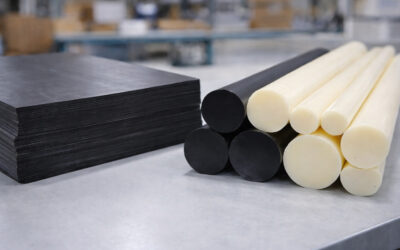
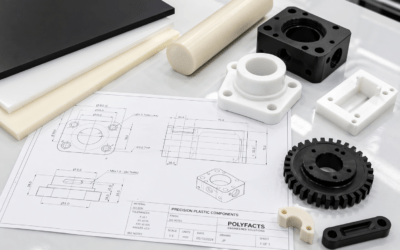
Custom plastic part specifications have a direct impact on quote accuracy, process selection, and overall project success. When the details behind a part are vague, quoting often slows down, revisions increase, and the path to the right material or process becomes...
Modern Plastics Blog
Stay up to date with Modern Plastics news, product updates, and insights on plastics distribution, fabrication, machining, and industrial materials.
Pharmaceutical Plastic Components: 7 Important Qualities to Review
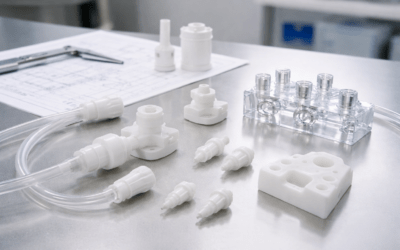
Pharmaceutical plastic components are used in demanding environments where consistency, cleanliness, and material performance all matter. In many pharmaceutical settings, a plastic part is not chosen simply because it is lightweight or corrosion-resistant. It is...
Semiconductor Plastic Materials: 6 Practical Roles in High-Purity Applications
Semiconductor plastic materials are used because semiconductor environments demand more than basic durability. These applications can involve harsh chemicals, high-purity requirements, resistance to electrical shock, static concerns, and contamination-sensitive...
Medical Device Plastic Materials: 7 Proven Benefits for Healthcare Applications
Medical device plastic materials are used because they help solve real performance challenges in healthcare applications. For engineers, buyers, and procurement teams, the value is not just that these materials are lightweight. It is that they can support precise...
Plastic Fabrication vs Machining: 6 Essential Factors to Compare
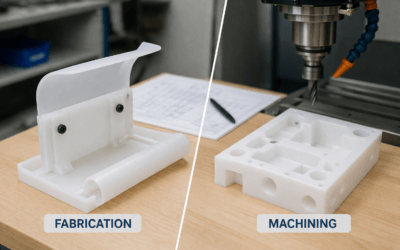
Plastic fabrication vs machining is a common question for engineers, buyers, and procurement teams evaluating custom plastic parts. While both approaches support industrial applications, they serve different purposes depending on the part design, tolerance...
Plastic RFQ Quote: 6 Essential Details for Faster, More Accurate Pricing
Plastic RFQ quote requests move faster when the right information is included at the start. For engineers, buyers, and procurement teams, a more complete RFQ helps reduce back-and-forth, improve quote accuracy, and make it easier to determine whether a project is best...
TECAPEEK: 7 practical spec tips for engineers
TECAPEEK is often evaluated when teams need a high-performance polymer for demanding environments and repeatable builds. But “TECAPEEK” alone isn’t enough to quote accurately—performance depends on grade, exposure conditions, and how you specify the supply format...
Valox plastic: 7 practical selection tips
Valox plastic is often chosen when teams need consistent performance, dimensional stability, and a clear path to repeat ordering—especially for parts tied to electrical, industrial, and documentation-driven programs. The challenge is that “Valox” gets used as...
9 Practical Medical Grade Plastic Questions
Medical grade plastic is not a single material you can order off a shelf—it’s a requirements label tied to your application, compliance expectations, cleaning or sterilization process, and documentation needs. When teams define those requirements early, sourcing...
7 Practical Delrin vs Acetal Differences
Delrin vs Acetal is one of the most common material questions we hear from engineers and procurement teams—because the names are often used interchangeably, while real-world requirements are not. The right choice depends on grade, environment, tolerance targets, and...
Medical device material traceability: 7 practical tips
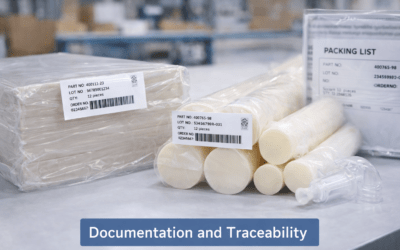
Medical device material traceability is one of the fastest ways to reduce risk in medical programs—because it connects what your team orders to what your team can prove. When traceability is defined early, procurement can request the right documentation, quality can...
High-performance plastics for fusion systems
High-performance plastics for fusion systems support complex assemblies where stability, cleanliness, and repeatability matter. Fusion-related projects can involve vacuum-adjacent interfaces, cryogenic temperature zones, and sensitive instrumentation—so material...