

Quick Answer
In agriculture, Acetal POM is valuable for irrigation, spraying, water management, greenhouse equipment, and moving machinery components because it combines moisture resistance, low friction, precision, and corrosion avoidance in moderate-duty environments.
What Acetal POM Is
Acetal is the common name for polyoxymethylene, often abbreviated as POM. It is a semi-crystalline engineering thermoplastic commonly supplied as sheet, rod, tube, and machined shapes. Many buyers also know it by brand or grade names such as Delrin® for acetal homopolymer and other copolymer acetal products. In practical industrial use, acetal is valued for low friction, good wear behavior, low moisture absorption, and the ability to machine cleanly into accurate parts.
For Modern Plastics customers, acetal is usually considered when a part must move repeatedly, maintain its dimensions, reduce metal-on-metal contact, or support a cleaner, lighter, corrosion-resistant design. The exact grade still matters. Homopolymer and copolymer acetal can behave differently, and filled, detectable, UV-stabilized, or compliance-oriented grades should be chosen only when they match the application requirements.
Key Properties and Performance Factors
- Low friction helps acetal perform well in gears, bushings, guides, rollers, and sliding interfaces where lubrication is limited or undesirable.
- Wear resistance makes it useful for medium-duty mechanical parts that cycle repeatedly under controlled loads.
- Low moisture absorption supports dimensional stability in humid, wet, or washdown-adjacent applications where nylon may move more with moisture.
- Machinability allows acetal to be cut, routed, turned, or milled into precise parts, prototypes, replacement components, and custom production pieces.
- Chemical resistance is useful with many oils, fuels, hydrocarbons, and neutral chemicals, but strong acids, oxidizers, chlorine-based exposure, or aggressive cleaners must be reviewed carefully.
- Electrical insulation can make acetal useful for spacers, guides, supports, and housings when metal is not desirable.
Common Acetal POM Agriculture Equipment Applications
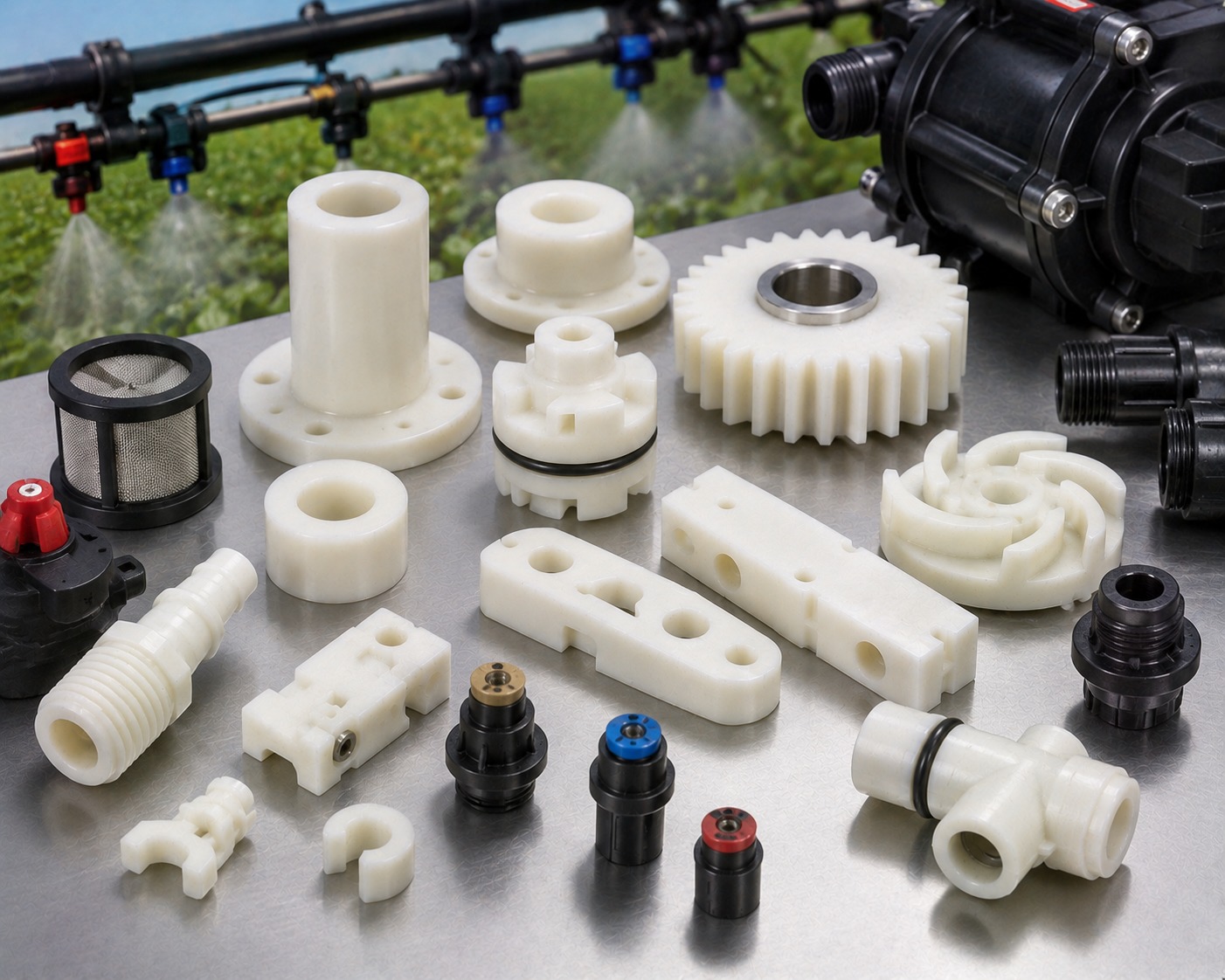
- Drip irrigation fittings, sprinkler heads, nozzle inserts, quick-connect couplings, valve bodies, and pressure regulator components
- Chemical sprayer nozzles, pump gears, impellers, flow meter components, solenoid valve parts, and dosing inserts
- Farm machinery bushings, bearings, rollers, conveyor guides, seed metering gears, and linkage pivots
- Livestock watering components, float valves, feed dispenser gears, and compliant grades for sanitation-sensitive equipment
- Greenhouse and controlled-environment agriculture parts including mist nozzles, nutrient dosing components, hydroponic valves, and shade-system gears
The common thread across these applications is not that acetal is a universal material. It is that acetal often fits parts where precision motion, reduced friction, repeatability, and resistance to corrosion or moisture are more important than extreme heat resistance or structural load capacity.
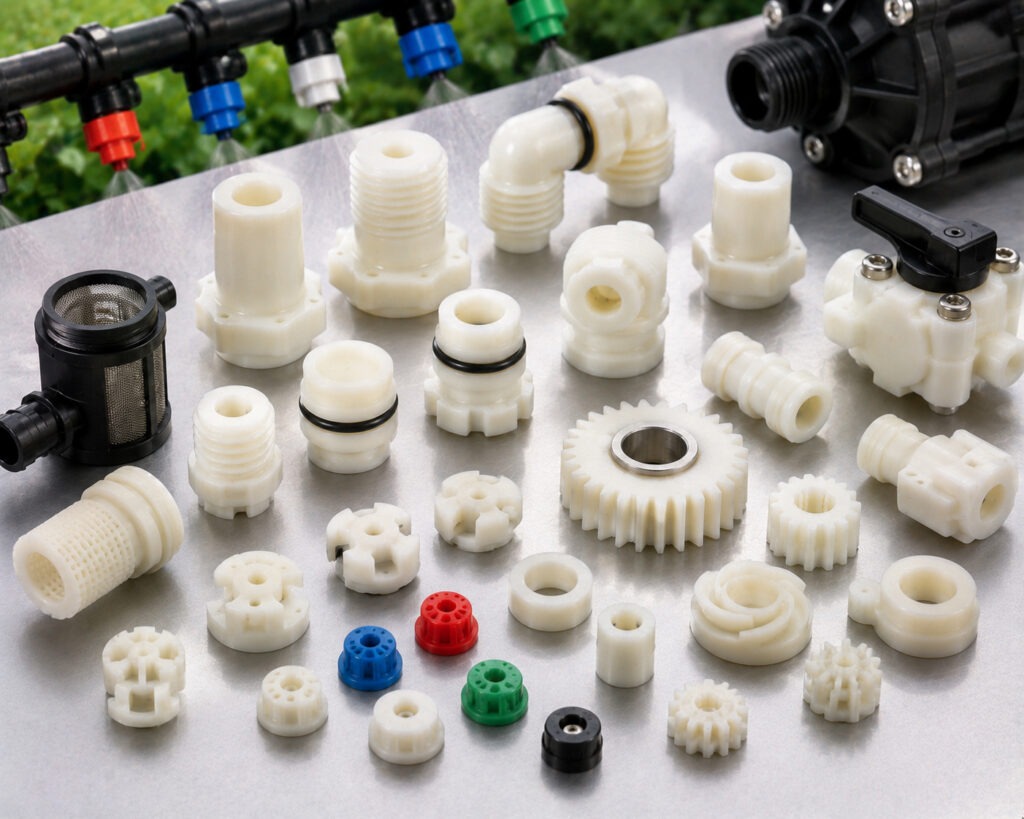
Acetal POM may be used in selected irrigation and sprayer components where precision, moisture stability, and repeatable flow support performance.
Important Selection Considerations for Acetal POM Agriculture Equipment
- Outdoor UV exposure is a key design issue; standard acetal may need a stabilized grade or protection.
- Fertilizers, pesticides, disinfectants, and oxidizers should be checked against the exact grade.
- Dusty field environments may favor low-lubrication materials because grease can attract debris.
- Moisture stability is important for irrigation components that need consistent sealing and flow.
When selecting Acetal POM agriculture equipment components, buyers should confirm the exact grade, UV exposure, fertilizer or pesticide contact, moisture conditions, operating temperature, and part geometry before production.
Engineers and purchasing teams should also consider the total cost of ownership. A slightly better material match can reduce maintenance, line downtime, lubrication requirements, premature wear, rework, or sourcing risk. A cheaper material that cannot hold tolerance or survive the service environment can cost more over the life of the part.
Comparisons and Alternatives
Acetal is often chosen when precision and moving mechanical performance matter. Polypropylene may provide better chemical resistance in some agricultural chemicals but lower stiffness. Nylon can be tough but absorbs more moisture. PVC is lower cost but may not offer the same wear or precision. Stainless steel provides durability but adds cost and weight.
Fabrication, Machining, and Documentation Notes
Acetal machines well, but design and processing choices still matter. Thin walls, sharp inside corners, large cross sections, aggressive tolerances, or unsupported features can affect final part stability. For production work, the drawing should identify critical dimensions, finish expectations, holes, slots, countersinks, chamfers, and inspection requirements.
Modern Plastics can support acetal projects with stock-shape sourcing, cut-to-size material, precision plastic machining support, custom fabrication support, and guidance on documentation needs when applicable. For documentation-driven markets, buyers should discuss grade requirements, manufacturer lot and batch traceability, certificates, test reports, and any customer-specific quality expectations before ordering.
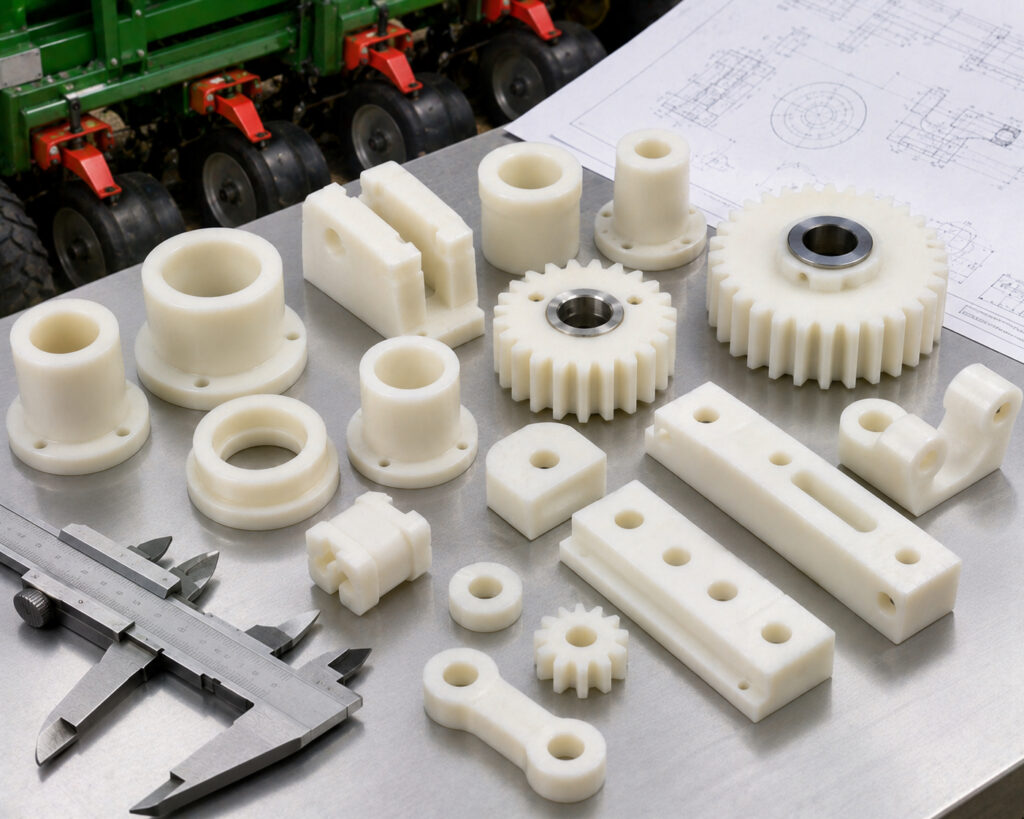
Machined Acetal POM bushings, rollers, and seed-metering components can support repeatable movement in properly matched farm machinery applications.
Why Modern Plastics
Modern Plastics is more than a source for plastic stock shapes. The team supports engineers, procurement teams, OEMs, and fabricators with material-selection guidance, precision cutting, machining support, fabrication support, and practical sourcing help for demanding applications. Modern Plastics is in business since 1945 and supports quality-focused customers with certifications including ISO 9001:2015, AS9100D, AS9120B, and ISO 13485:2016.
For acetal applications, that experience matters because the best answer is often not simply “use acetal.” The better question is which grade, in what shape, under what load, exposed to what environment, and with what documentation expectations. When sourcing Acetal POM agriculture equipment components, Modern Plastics can help customers review those decisions before material is ordered or parts are produced.
Is Acetal the Right Material for Agricultural Equipment?
Acetal POM agriculture equipment can be a strong choice when the application calls for low friction, dimensional stability, wear resistance, moisture resistance, and reliable machining. It is not the answer for every high-heat, structural, UV-heavy, or chemically aggressive environment, but when the service conditions match the material profile, acetal can help improve performance, reduce maintenance, and support repeatable production. If you are evaluating Acetal POM agriculture equipment components, the right grade and design should be matched to the part’s UV exposure, chemical exposure, dirt, moisture, load, and service environment.
Frequently Asked Questions About Acetal in Agriculture and Irrigation Equipment
Where is Acetal POM used in agriculture?
Acetal POM is commonly used in agriculture and irrigation equipment for irrigation fittings, sprinkler parts, sprayer nozzles, pump gears, valve components, seeder mechanisms, bushings, and greenhouse system parts. It is usually selected for precision motion, low friction, wear resistance, and dimensional stability rather than extreme heat or structural load service.
Why is acetal useful for irrigation and sprayer components?
Acetal POM is useful because it combines low friction, wear resistance, machinability, low moisture absorption, and good dimensional stability. In agriculture and irrigation equipment, those properties can help reduce lubrication needs, improve repeatability, and support reliable movement in properly matched applications.
Can acetal be used outdoors in agricultural equipment?
Acetal may be used outdoors in selected agricultural applications, but UV exposure should be reviewed carefully. Standard acetal may need a UV-stabilized grade, shielding, or protective design depending on sun exposure, part geometry, and expected service life.
When should acetal not be used with fertilizers or chemicals?
Acetal POM is usually not the best choice for strong acids, oxidizers, aggressive disinfectants, severe UV exposure without stabilization, continuous high heat, structural heavy-load parts, or extreme abrasion/impact zones. The application should be reviewed for UV exposure, fertilizers, pesticides, moisture, dirt, load, and chemical compatibility before the material is selected.
How does acetal compare with polypropylene, nylon, or stainless steel?
Acetal is often strongest where precision, low friction, wear resistance, and dimensional stability are priorities. Polypropylene may be better for certain chemical exposures, nylon may offer toughness but absorbs more moisture, and stainless steel may be preferred for structural strength, harsh service, or long outdoor durability.
Can Modern Plastics help source custom agricultural components?
Yes. Modern Plastics can help review the application, compare material options, source stock shapes, support machining or fabrication needs, and discuss documentation expectations. For agriculture and irrigation equipment, it is best to confirm grade, environment, tolerances, and traceability needs before ordering.
Talk to Modern Plastics About Your Application
Whether you need help choosing the right plastic material, comparing performance properties, improving manufacturability, reviewing documentation requirements, or sourcing stock shapes and fabricated components, the Modern Plastics team is ready to help.
0 Comments