

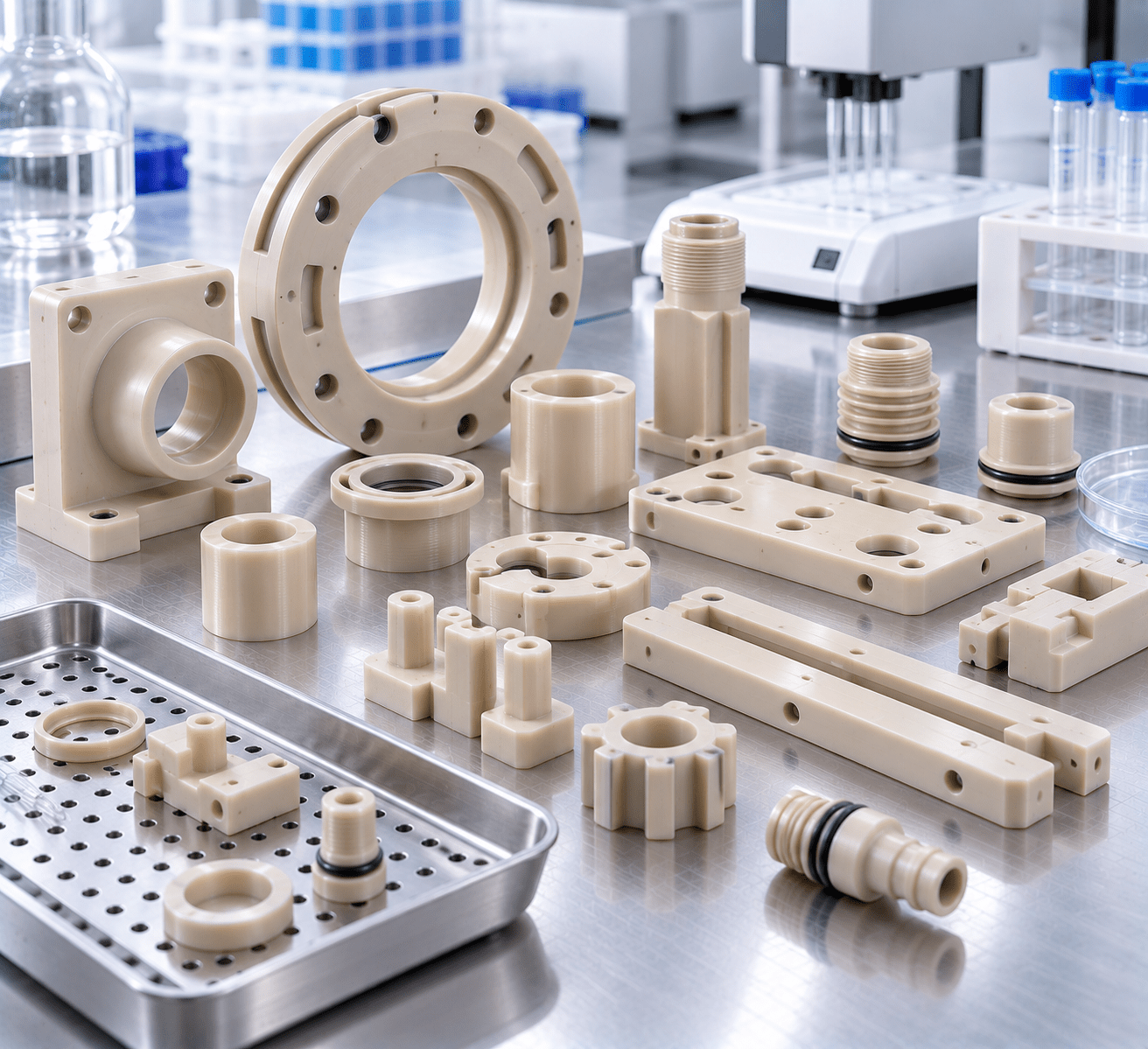
The key is not simply selecting PEEK. Successful applications require choosing the correct grade, manufacturing method, documentation package, and design approach. Many Modern Plastics customers compare PEEK against materials such as ULTEM™ PEI, PPS, PVDF, PTFE, acetal, nylon, stainless steel, and titanium when determining the best material for their application.
Quick Answer
PEEK is one of the highest-performing engineering thermoplastics available and is often selected for life sciences applications requiring sterilization resistance, strength, chemical resistance, dimensional stability, and long-term reliability.
What PEEK Is
PEEK, or polyetheretherketone, is a semi-crystalline high-performance thermoplastic known for its exceptional mechanical properties, wear resistance, and broad chemical compatibility.
Unlike many engineering plastics, PEEK maintains strength and stiffness at elevated temperatures while resisting hydrolysis and repeated sterilization cycles. Medical-grade formulations are widely used throughout the healthcare and life sciences industries due to their biocompatibility and proven performance.
PEEK is available in stock shapes including sheet, rod, tube, and film, as well as injection molded, machined, and fabricated components. Unfilled, glass-filled, carbon-filled, bearing-grade, and implantable grades offer different performance characteristics depending on the application.
Key Properties and Performance Factors
- Excellent mechanical strength and stiffness across a wide temperature range.
- Outstanding chemical resistance to a broad range of solvents, cleaners, and process chemicals.
- Exceptional wear and abrasion resistance for moving and contacting components.
- Resistance to steam, moisture, and hydrolysis during sterilization processes.
- Dimensional stability that supports tight tolerances and precision assemblies.
- Biocompatibility in select medical grades used for healthcare applications.
- High continuous-use temperatures compared to many engineering plastics.
- Radiolucency advantages in certain medical imaging environments.
PEEK is frequently chosen when engineers require a balance of performance characteristics that few other thermoplastics can provide simultaneously.
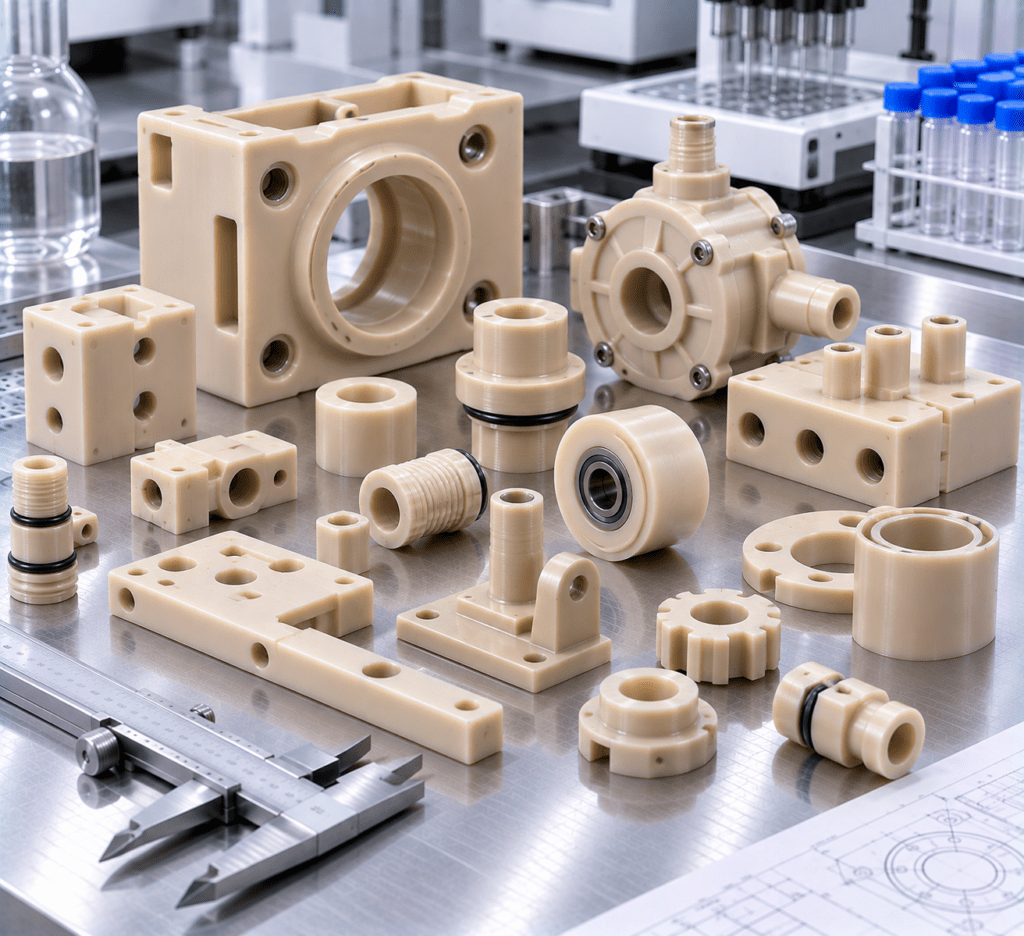
PEEK diagnostic and laboratory system components shown with inspection tools and clean technical hardware.
Common PEEK Life Sciences Component Uses
- Orthopedic implants and spinal device components
- Surgical instrument components and handles
- Drug delivery systems and diagnostic equipment
- Bioprocessing hardware and fluid management systems
- Medical imaging equipment components
- Laboratory automation systems and robotic assemblies
- Analytical instrumentation components
- Sterilization trays and reusable medical device hardware
- Pump components, bearings, valve seats, and seals
The common thread among these applications is the need for long-term performance under demanding mechanical, thermal, chemical, or sterilization conditions.
Important Selection Considerations for PEEK Components
- Verify sterilization requirements, including autoclave, ETO, gamma radiation, or plasma sterilization.
- Determine whether implantable, patient-contact, fluid-contact, or laboratory-use grades are required.
- Evaluate temperature exposure, load conditions, wear requirements, and chemical compatibility.
- Review documentation needs, including traceability, material certifications, and regulatory requirements.
- Compare filled and unfilled grades based on dimensional stability and mechanical performance objectives.
Although PEEK is one of the most capable engineering plastics available, it is generally more expensive than ULTEM, acetal, nylon, and many other thermoplastics. Its value is maximized when application requirements justify its advanced performance characteristics.
Comparisons and Alternatives
PEEK is frequently compared with ULTEM™ PEI, PPS, PVDF, PTFE, UHMW, stainless steel, and titanium.
ULTEM may provide a lower-cost solution when electrical insulation and heat resistance are the primary concerns. PTFE may perform better in extremely low-friction applications. PVDF can be an excellent choice for highly corrosive fluid handling environments. Stainless steel and titanium may remain preferred for very high structural loading applications.
Material selection should always be based on the actual application requirements, including sterilization methods, operating temperatures, chemical exposure, documentation expectations, and budget considerations.
Fabrication, Machining, and Documentation Notes
PEEK machines exceptionally well and is commonly used for precision CNC-machined components requiring tight tolerances.
Design considerations such as wall thickness, internal corners, tolerances, surface finish requirements, and assembly methods remain important for long-term component performance. Stock shape availability, material certification requirements, and traceability expectations should be discussed during the design phase.
For regulated industries such as medical devices, pharmaceuticals, biotechnology, and diagnostics, documentation and material traceability often play a significant role in material selection.
Why Modern Plastics
Modern Plastics supports customers with high-performance plastic stock shapes, precision cutting, CNC machining, fabrication services, and material selection expertise.
The Modern Plastics team works with medical device manufacturers, life sciences OEMs, laboratories, and research organizations to help identify the most appropriate engineering plastics for demanding applications. Whether comparing PEEK to other high-performance thermoplastics or sourcing finished components, Modern Plastics provides practical guidance and manufacturing support throughout the process.
Is PEEK the Right Material for This Application?
PEEK life sciences components can be an excellent solution when applications demand a combination of strength, chemical resistance, sterilization durability, dimensional stability, wear performance, and long-term reliability. While it may not be necessary for every project, PEEK often becomes the preferred choice when performance requirements exceed the capabilities of traditional engineering plastics.

CNC-machined PEEK laboratory equipment components beside calipers and an engineering drawing.
Frequently Asked Questions About PEEK for Life Sciences, Diagnostics, and Laboratory Systems
Where is PEEK used in life sciences applications?
PEEK is used in orthopedic implants, spinal devices, surgical instruments, laboratory equipment, diagnostic systems, bioprocessing hardware, analytical instruments, fluid management systems, and medical device components.
Why do life sciences OEMs choose PEEK?
Life sciences OEMs select PEEK because it provides high mechanical strength, chemical resistance, sterilization durability, biocompatibility, dimensional stability, and long-term reliability.
Can PEEK be used in bioprocessing systems?
Yes. PEEK is commonly used in bioprocessing equipment, fluid-handling systems, manifolds, pumps, valves, and analytical instrumentation where chemical resistance and sterilization performance are important.
Is PEEK used in implantable medical devices?
Certain medical-grade and implant-grade PEEK materials are used in spinal, orthopedic, and trauma implant applications due to their biocompatibility and mechanical properties. The exact grade, documentation, and regulatory requirements must always be reviewed.
Can PEEK withstand sterilization?
PEEK can withstand many repeated sterilization processes, including steam autoclave, ethylene oxide, and gamma sterilization, depending on the grade, part design, and exposure conditions.
Can Modern Plastics help select PEEK for life sciences projects?
Yes. Modern Plastics can help evaluate material options, compare performance properties, review documentation requirements, source stock shapes, and support machining and fabrication needs for PEEK components.
Talk to Modern Plastics About Your Application
Whether you need help selecting the right engineering plastic, comparing material performance, reviewing manufacturability, sourcing stock shapes, or producing precision-machined components, the Modern Plastics team is ready to help with your next life sciences project.
0 Comments