

Quick Answer
Qualified medical and implant-grade PEEK can support precision healthcare components that require strength, chemical resistance, radiolucency, sterilization performance, and documented traceability.
What PEEK Is
PEEK, or polyetheretherketone, is a semi-crystalline high-performance engineering thermoplastic used when a component must retain useful mechanical, dimensional, thermal, or chemical performance under demanding service conditions. It is commonly supplied as sheet, plate, rod, tube, and precision-machined components.
Unfilled, glass-filled, carbon-filled, bearing-grade, medical-grade, and other specialized PEEK formulations can perform differently. Material selection should therefore be based on the exact grade, operating environment, finished-part design, and documentation requirements.
Key Properties and Performance Factors
PEEK offers a unique combination of properties that make it a material considered for demanding medical applications:
- Biocompatibility support for qualified medical grades
- High strength-to-weight ratio
- Outstanding wear and fatigue resistance
- Excellent chemical and hydrolysis resistance
- Low moisture absorption
- Exceptional dimensional stability
- Resistance to repeated steam, gamma, and EtO sterilization
- Radiolucency for clear X-ray, CT, and MRI imaging with minimal imaging artifacts
- Long service life in demanding environments
These characteristics allow PEEK to replace metal in many applications while providing reduced weight, improved imaging compatibility, and outstanding long-term reliability.
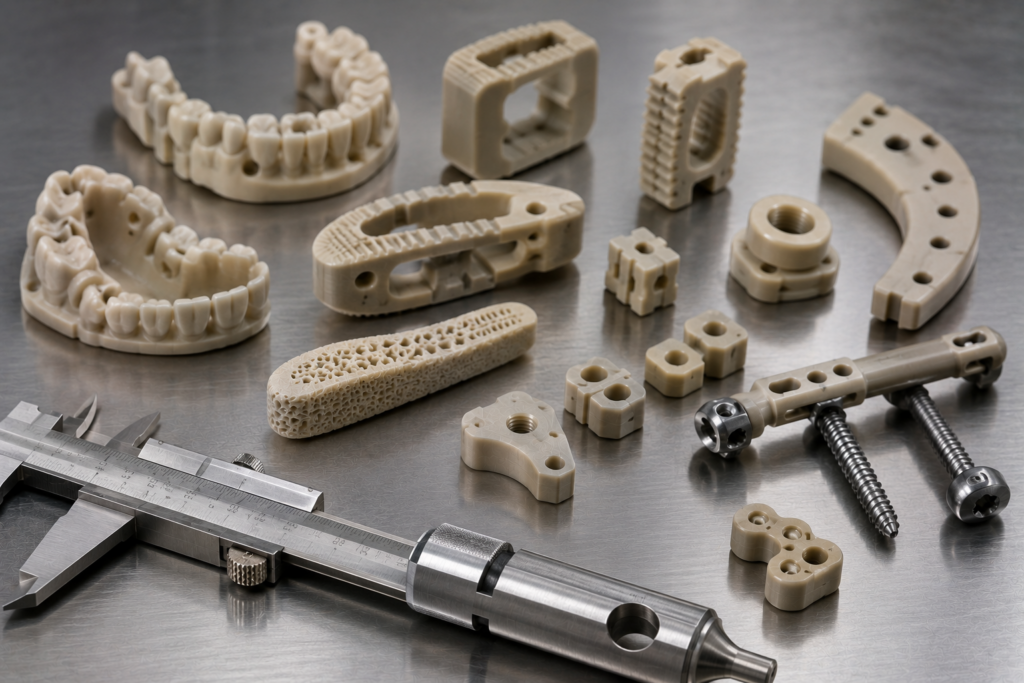
Medical-grade and implant-grade PEEK must be selected and documented for the exact intended use.
Common Applications in Medical Device and Healthcare Components
PEEK is used in a wide variety of medical devices and components, including:
Orthopedic Implants
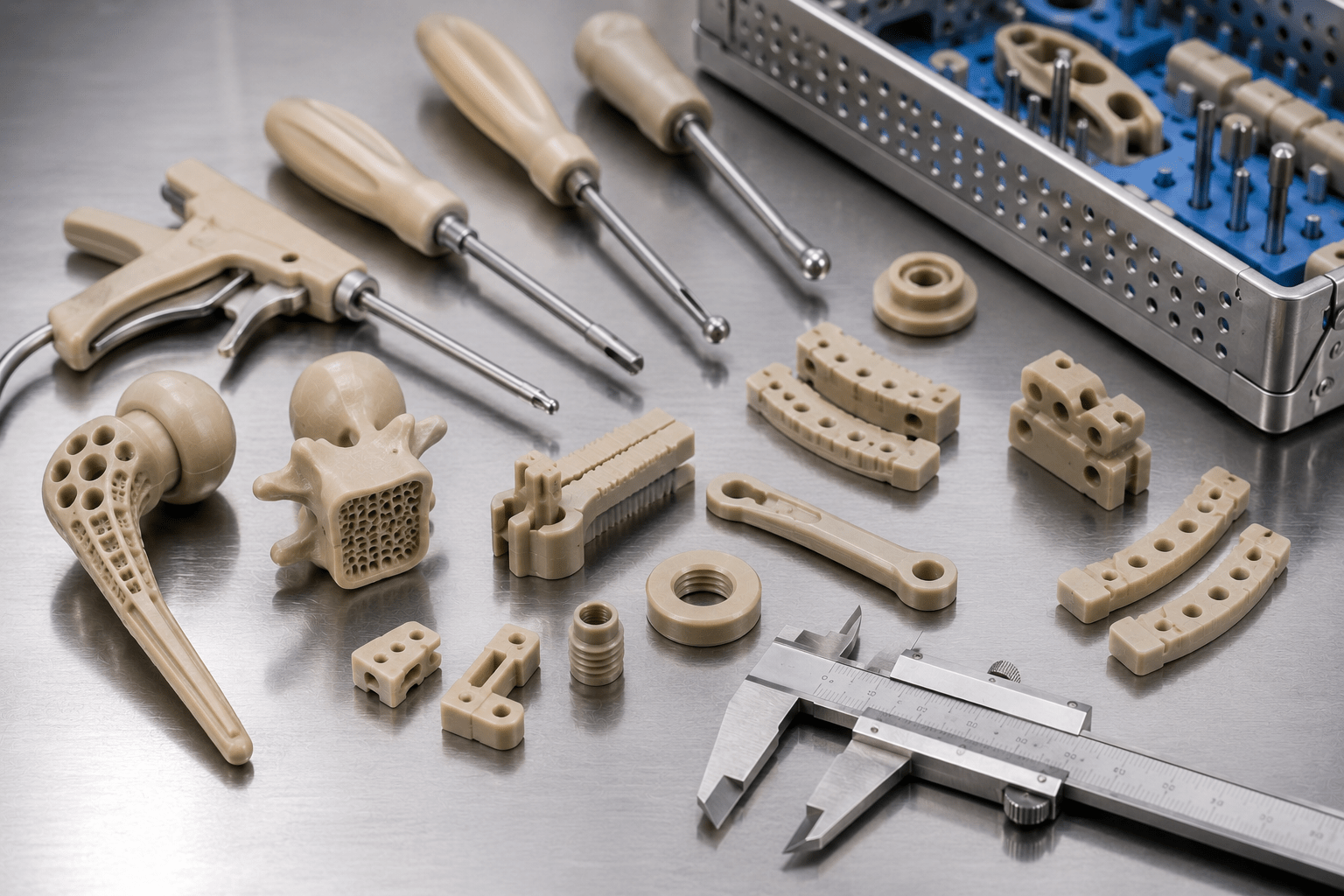
PEEK is commonly used in spinal fusion cages, trauma fixation devices, and joint replacement components. Because its elastic modulus is similar to that of human bone, it can help reduce stress shielding while promoting better load sharing and patient outcomes.
Surgical Instruments
Manufacturers use PEEK for handles, grips, and structural components of reusable surgical instruments. The material maintains its mechanical properties after repeated steam (autoclave), gamma, and ethylene oxide (EtO) sterilization cycles.
Medical Devices
PEEK is found in diagnostic equipment, imaging systems, infusion pumps, ventilators, and patient-monitoring devices where lightweight, durable, and chemically resistant components are essential.
Dental Applications
Medical-grade PEEK is increasingly used for dental implant abutments, prosthetic frameworks, crowns, and removable partial dentures because of its strength, biocompatibility, and natural appearance.
Catheters and Drug Delivery Systems
PEEK tubing and precision-machined components provide excellent dimensional stability, chemical resistance, and low moisture absorption, making them candidates for minimally invasive medical devices and fluid delivery systems.
Laboratory and Analytical Equipment
PEEK is widely used for valves, fittings, manifolds, connectors, and fluid-handling components that must withstand aggressive chemicals while maintaining precise tolerances.
Sterilization Equipment
Hospitals and medical device manufacturers use PEEK in sterilization trays, instrument organizers, and other equipment designed to endure repeated high-temperature sterilization cycles.
Important Selection Considerations for PEEK medical applications
- Confirm whether the component is non-contacting, externally communicating, implantable, or otherwise subject to patient-contact requirements.
- Verify that the exact medical or implant grade supports the intended use and required documentation.
- Evaluate the sterilization method, cycle conditions, cleaning chemistry, and expected number of reprocessing cycles.
- Review mechanical load, wear, imaging requirements, tolerances, and traceability before specification.
Engineers and purchasing teams should also consider total cost of ownership. A material and grade that machine predictably, hold appropriate tolerances, and perform consistently in the actual environment can reduce downtime, premature wear, rework, and replacement cost.
Comparisons and Alternatives
For medical and healthcare components, PEEK may be compared with PPSU, PSU, ULTEM™ PEI, PPS, PTFE, ceramics, titanium, stainless steel, or other qualified materials. The appropriate choice depends on patient contact, sterilization, imaging, mechanical load, chemical exposure, documentation, and cost.
Fabrication, Machining, and Documentation Notes
PEEK machines well, but its material cost and performance expectations make drawing review and process planning especially important. Thin walls, deep pockets, sharp internal corners, large cross sections, aggressive tolerances, and unbalanced stock removal can affect final part stability.
Production drawings should identify the exact grade, critical dimensions, surface finish, holes, threads, sealing features, inspection methods, and documentation requirements. Manufacturer, lot traceability, certificates, test reports, and customer-specific quality expectations should be discussed before material is released.
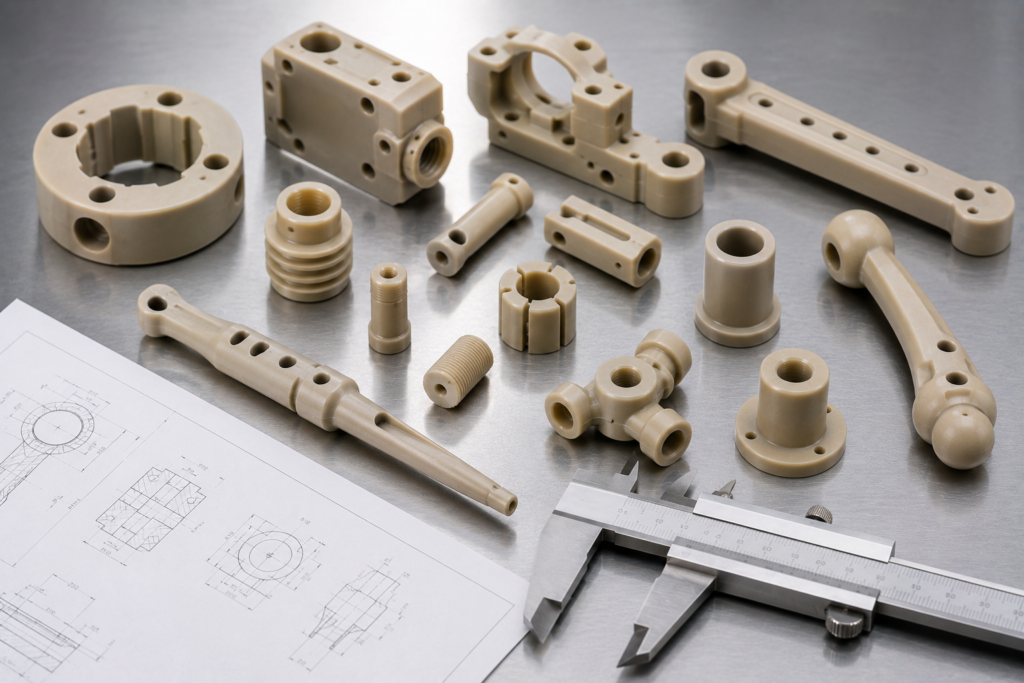
Precision machining and documented inspection support repeatable PEEK medical components.
Why Modern Plastics
Modern Plastics is a trusted supplier of medical-grade and implant-grade PEEK stock shapes, including sheet, rod, tube, and custom-cut components. The company provides materials from leading manufacturers with complete material traceability and is ISO 13485 certified to support the stringent quality requirements of the medical device industry.
In addition to supplying premium PEEK materials, Modern Plastics offers precision fabrication and CNC machining services for prototype development and full-scale production. Whether your application involves implantable devices, surgical instruments, laboratory equipment, or diagnostic systems, Modern Plastics has the expertise and inventory to help bring your medical product to market with confidence.
Is PEEK the Right Material for Medical Devices and Healthcare Applications?
PEEK medical applications can be a strong fit when the application requires a demanding combination of thermal performance, mechanical strength, dimensional stability, chemical resistance, wear performance, or electrical insulation. PEEK is not automatically the best or most economical choice for every part, so the exact grade and alternatives should be compared against the real service conditions before a final specification is approved.
Frequently Asked Questions About PEEK for Medical Devices and Healthcare Applications
Where is PEEK used in medical applications?
Qualified PEEK grades are used in selected orthopedic and dental devices, reusable surgical instruments, diagnostic equipment, catheters, fluid-handling components, laboratory equipment, and sterilization hardware. Implantable use requires an implant-grade material and application-specific regulatory review.
Is every PEEK grade suitable for medical or implant use?
No. General industrial PEEK should not be assumed suitable for patient contact or permanent implantation. The exact medical or implant grade, manufacturer documentation, biological evaluation, sterilization method, and device requirements must be verified.
Can PEEK withstand repeated sterilization?
Many qualified PEEK grades tolerate repeated steam, gamma, and ethylene oxide sterilization, but performance depends on the grade, geometry, cycle parameters, cleaning chemistry, and number of cycles. The finished device and labeled reprocessing method should be validated.
Why is PEEK used in imaging-compatible implants?
PEEK is radiolucent and can produce fewer imaging artifacts than many metals. Imaging performance and any radiopaque additives should be evaluated for the exact grade and device design.
Can Modern Plastics supply traceable medical-grade PEEK?
Modern Plastics supplies medical-grade and implant-grade PEEK stock shapes and can support material documentation, traceability, cutting, and precision machining requirements for qualified programs.
Talk to Modern Plastics About Your Application
Whether you need help choosing the right plastic material, comparing performance properties, improving manufacturability, reviewing documentation requirements, or sourcing stock shapes and fabricated components, the Modern Plastics team is ready to help.
0 Comments