

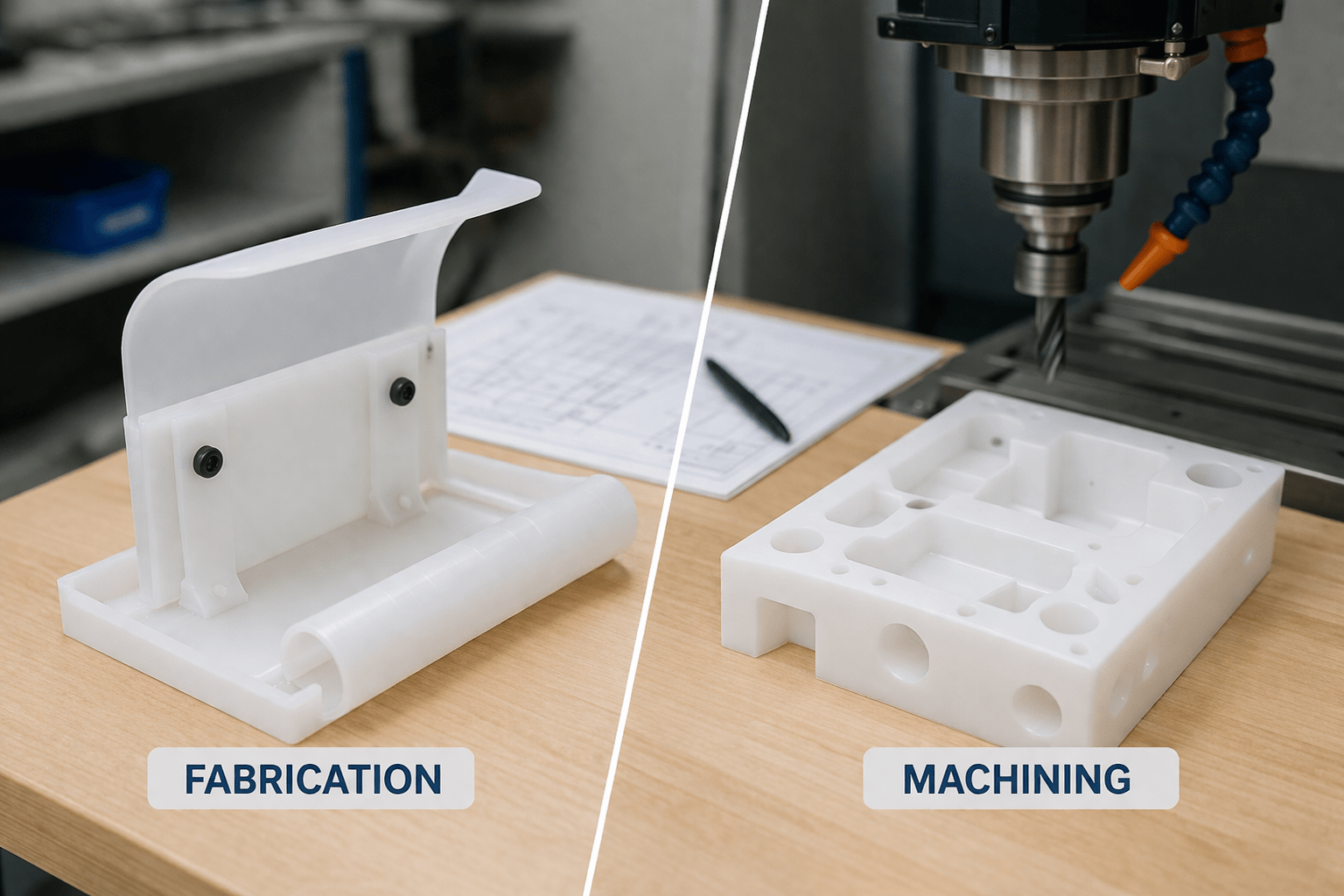
Why Plastic Fabrication vs Machining Matters
The choice between plastic fabrication vs machining affects cost, process flow, inspection needs, and part performance. Choosing the right method early helps reduce redesigns and avoids unnecessary production complexity.
Modern Plastics supports customers with:
- material distribution
- fabrication
- machining
- precision cutting
- CNC routing
That makes it easier to match the process to the project.
Buyers comparing manufacturing methods may also benefit from the industry resources available through the Plastics Industry Association.
6 Essential Factors in Plastic Fabrication vs Machining
1. Part Geometry
Geometry is one of the first factors to review. Flat panels, formed components, covers, guards, and assembled pieces often align well with fabrication. More complex features, contours, and precision details often point toward machining.
When geometry becomes more intricate, machining usually provides better dimensional control.
2. Tolerance Requirements
Tolerance expectations can strongly influence the decision. Loose to moderate tolerances may support fabrication, while tighter tolerances often favor machining.
This is especially true when the part must fit into a larger assembly or perform within narrow dimensional limits. The more critical the dimensions, the more likely machining becomes the better process.
3. Part Size
Part size matters because larger structures may be more practical to fabricate, while smaller precision components may be more practical to machine.
Fabrication is often a strong fit for larger sheet-based components. Machining is often preferred when part size is smaller but feature precision is higher.
Plastic Fabrication vs Machining for Application Details
The decision around plastic fabrication vs machining should also account for how the part will function in the field.
4. Application Details
Application-specific requirements can influence both material selection and process choice.
Mechanical Properties
Specify load requirements, impact resistance, wear resistance, stiffness, tensile strength, or fatigue expectations. Note whether the part is structural, non-structural, or subject to motion or abrasion.
Thermal Requirements
Include continuous operating temperature, peak temperature exposure, and whether the part will experience thermal cycling or heat deflection concerns.
Chemical Exposure
Identify any exposure to chemicals, oils, solvents, cleaners, fuels, acids, or alkaline environments, including concentration and frequency if known.
Electrical Considerations
Indicate insulation, conductivity, static-dissipative, or dielectric requirements if applicable.
Regulatory Compliance
Call out requirements such as FDA, NSF, UL, USP Class VI, ASTM, aerospace, medical, or food-contact standards.
These details help determine whether a fabricated part, machined component, or CNC-routed solution is the better fit.
5. Volume and Repeatability
Production volume can influence efficiency. Some lower-complexity parts may be efficiently fabricated or precision cut in quantity, while highly detailed components may still require machining for repeatability.
Volume alone does not decide the process, but it does affect how the work is evaluated for practicality and consistency.
6. Quality and Inspection Expectations
Inspection requirements should be considered early. If the part needs dimensional reports, traceability, or tighter verification, machining may be the more appropriate route. If the job is more structural or assembly-based, fabrication may still be the right choice depending on the critical requirements.
Quality expectations should always be matched to how the part will be used.
A Practical Checklist for Process Selection
Before deciding between fabrication and machining, review:
- part geometry
- tolerance requirements
- part size
- application details
- production volume
- quality expectations
This checklist helps engineers and buyers compare custom plastic manufacturing methods more clearly.
When Both Processes May Be Needed
Some jobs are not purely fabrication or purely machining. A fabricated assembly may include machined features. A machined part may begin as a distributed stock shape and require precision cutting or CNC routing before final processing.
Modern Plastics supports this kind of review by helping customers compare the requirements instead of forcing the part into a single method too early.
FAQs
What is plastic fabrication vs machining?
Plastic fabrication vs machining refers to two different ways of producing plastic components. Fabrication usually involves cutting, forming, joining, or assembling material, while machining removes material to create more precise features and dimensions for finished plastic parts.
When should I choose fabrication instead of machining?
Fabrication is often the better option for larger components, sheet-based parts, formed structures, and assemblies that do not require highly complex geometry or tight tolerances. It can also be a practical choice when efficiency matters more than precision feature detail.
When is machining the better choice for plastic parts?
Machining is usually the better choice when a part needs tighter tolerances, detailed features, repeatable dimensions, or close fit within a larger assembly. It is commonly used for precision components where dimensional control is critical to performance.
Can one project use both fabrication and machining?
Yes. Some projects require a combined approach. A part may start from distributed stock material, move through precision cutting or CNC routing, and then include fabricated or machined features depending on the final design and application requirements.
If your team is comparing part production options, Modern Plastics can help review the design, application, and quality requirements to determine whether fabrication, machining, precision cutting, or CNC routing is the better fit. The right process choice early can support better performance and fewer delays later.
0 Comments