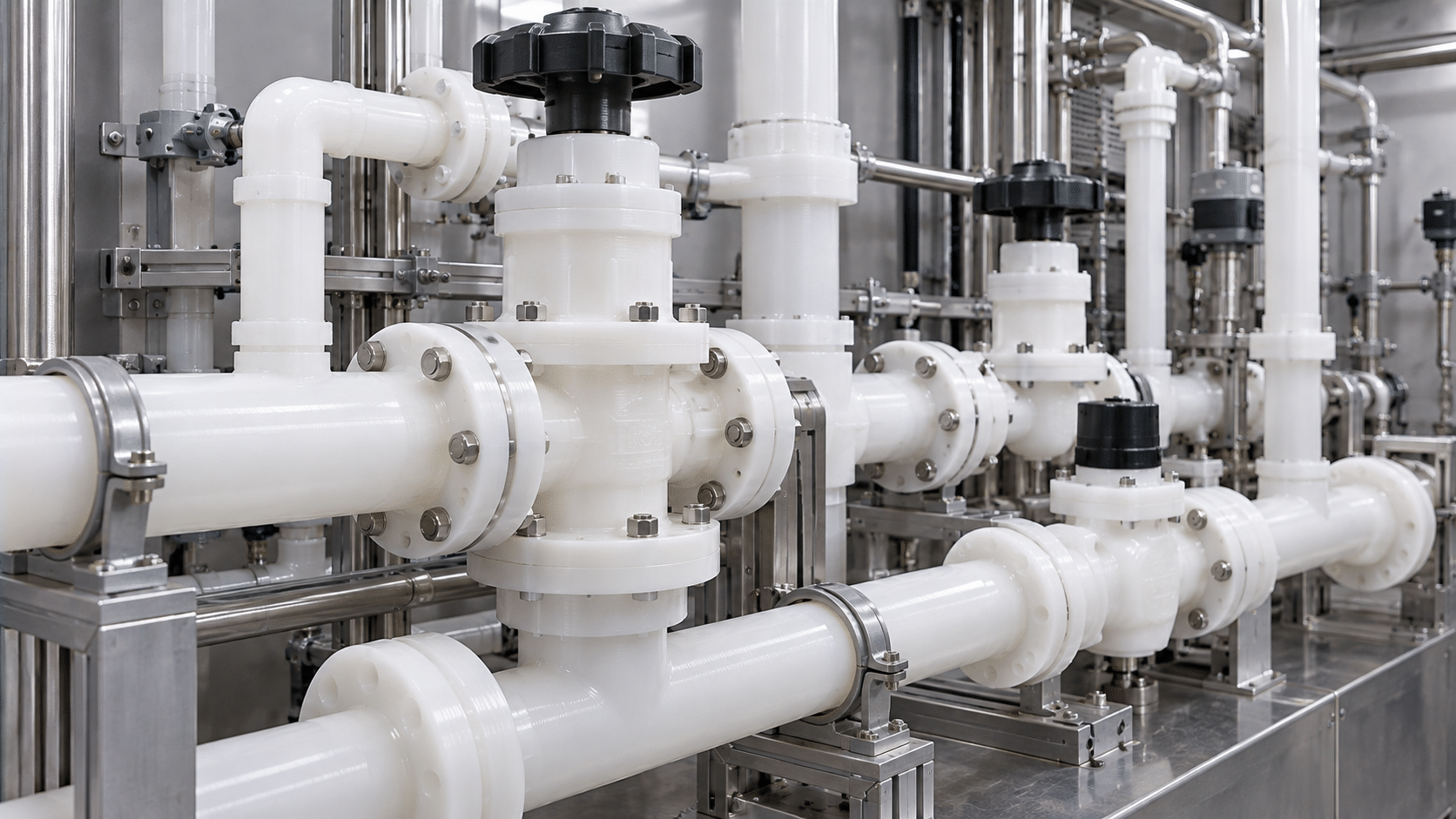
Modern Plastics supplies engineering plastic stock shapes and precision-machined components. For a PVDF fluidics project, that starts with understanding what the part will contact, how it will operate and which dimensions or cleanliness requirements are critical.
Manifolds, valve bodies, fittings and sensor housings serve different purposes, even when they share the same material family. A useful specification connects the selected PVDF grade with the finished component and the conditions it will experience.
Quick Answer
PVDF for fluidics applications is a candidate when chemical resistance, dimensional performance and precision machining are priorities. Selected grades can support purity requirements, but material, cleaning, inspection and packaging must be specified for the intended service.
What PVDF Is
PVDF stands for polyvinylidene fluoride. This fluoropolymer is used in demanding fluid-handling applications where chemical compatibility and mechanical performance matter. Natural stock shapes are generally opaque white; PVDF should not be specified when a clear viewing window is needed. Grade-specific data governs the final material choice.
Key Properties and Performance Factors
Chemical resistance
PVDF resists a broad range of chemicals, making it a candidate for demanding fluid exposure. Resistance is not universal. The exact chemical, concentration, temperature and exposure time must be considered together before a material is specified.
Grade options for purity requirements
PVDF grades are available for applications where contamination control matters. A resin family name alone does not establish finished-part purity. The selected stock material, machining process, cleaning method and packaging all need to align with the application’s requirements.
Mechanical performance
PVDF offers useful strength and rigidity for many fluid-handling components. The design still needs to account for assembly loads and service conditions. A valve body, for instance, must be evaluated as a complete part with its seals, fasteners and connections.
Dimensional performance in wet environments
Low moisture uptake can be useful when dimensional consistency matters in fluidics equipment. Temperature changes and sustained loading remain relevant, particularly around sealing surfaces and close-tolerance interfaces. Specify dimensions for the actual operating requirements rather than relying only on a room-temperature fit.
Precision machining
PVDF stock shapes can be machined into custom parts with application-specific ports, bores and mounting features. This gives equipment designers flexibility when standard components do not match the required layout. Drawing review helps connect material selection with practical manufacturing requirements.
Common PVDF Fluidics Uses
PVDF may be considered for chemical processing, water treatment, analytical equipment and semiconductor fluid-handling systems. High-purity and pharmaceutical applications require additional review of the specific grade, documentation and finished-part handling.
Potential components include:
- Custom manifolds and fluid distribution blocks
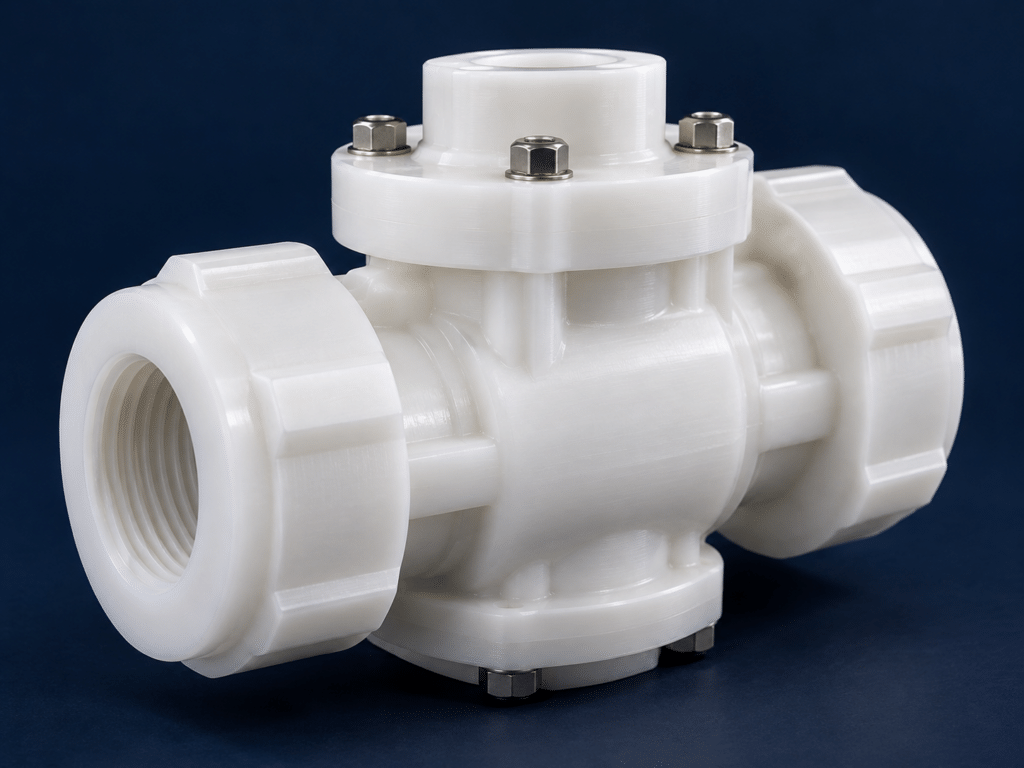
- Valve bodies, valve seats and pump components
- Fittings and connectors
- Sensor and instrumentation housings
- Bushings and other application-specific mechanical parts
- Components for high-purity fluid-handling equipment
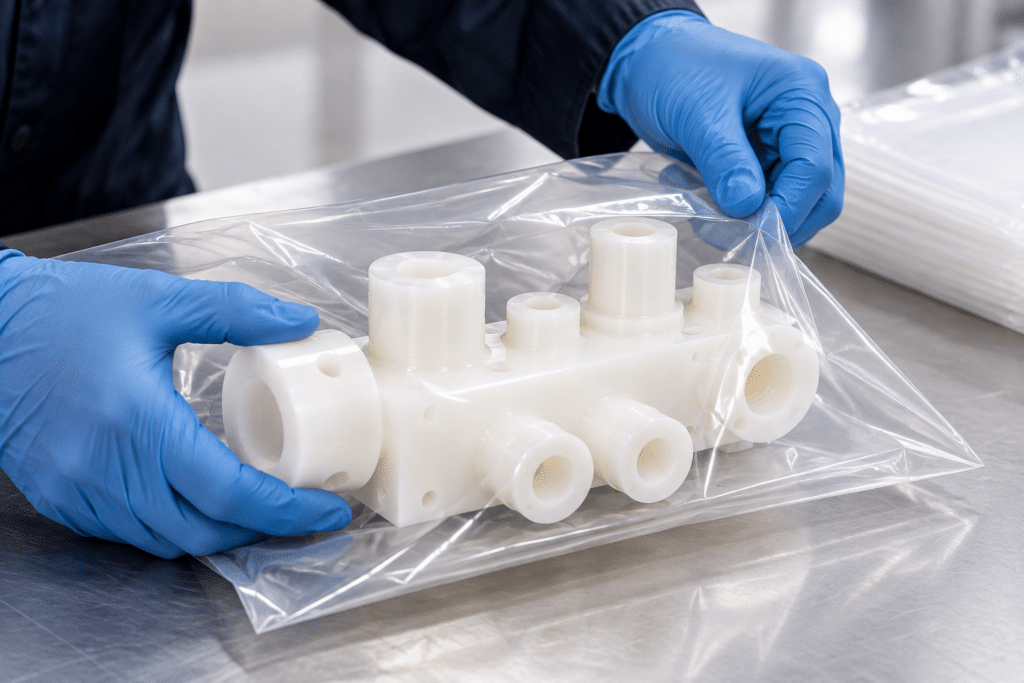
For example, a distribution block may combine several fluid connections in one machined part. Reviewing the drawing early helps identify intersecting passages, sealing surfaces and access needed to inspect or clean the internal flow path.
Important Selection Considerations for PVDF for Fluidics Applications
Start with the process fluid and its full operating range. Include cleaning agents, flush cycles and occasional exposure conditions, because a component may encounter more than the fluid it handles during normal production.
Different PVDF formulations and stock products can have different properties. Specify the actual grade and required documentation. Do not assume that every PVDF product carries the same purity, contact-use or other application qualifications.
For chemical service, consult the manufacturer’s compatibility information and evaluate the finished part under the intended conditions. Arkema’s chemical resistance guidance describes how temperature, concentration, exposure and mechanical loading can affect performance.
Pressure capability also belongs to the complete component or assembly. A general material description does not provide a pressure rating for a custom manifold, fitting or valve body.
Comparisons and Alternatives
Transparent plastics such as polycarbonate and cast acrylic can support visibility-focused components, but they are not direct substitutes for PVDF in demanding chemical service. Other fluoropolymers or engineering plastics may also warrant review when chemistry, temperature, wear or cleanliness dominates the specification.
Compare the actual grades and finished designs. A material that fits one process stream may be unsuitable for a different concentration, cleaning cycle or operating temperature.
Fabrication, Machining, and Documentation Notes
Modern Plastics can support your project with stock material and custom machining. Share a drawing that identifies the fluid passages, seal interfaces, critical tolerances and connection details, along with expected quantities and operating conditions.
Our plastic fabrication services help connect the material requirement with the finished part. For components intended for demanding fluid service, include inspection requirements in the initial conversation so they can be considered with the manufacturing plan.
When cleanliness is important, define it explicitly. Surface condition, allowable residues, handling and packaging should be discussed as project requirements. Avoid assuming that a material described as high purity automatically produces a qualified finished assembly.
Identify critical dimensions, sealing surfaces, finish expectations and inspection requirements on the drawing. Discuss grade identification, lot traceability and material documentation before ordering. Any required cleaning or packaging process should be agreed for the specific project.
Why Modern Plastics
Modern Plastics supports fluidics projects with engineering plastic stock shapes, material-selection guidance and custom machining or fabrication. Sharing the component drawing and operating conditions helps our team discuss suitable material options and production requirements.
Explore our plastic fabrication services or request a quote with your drawing, quantity and documentation needs.
Is PVDF the Right Material for This Application?
PVDF for fluidics applications is a candidate when chemical resistance, dimensional performance and precision machining are priorities. Selected grades can support purity requirements, but material, cleaning, inspection and packaging must be specified for the intended service. Review the component as part of the complete system, including cleaning exposure, sealing and service loads, before finalizing the specification.
Frequently Asked Questions
Why consider PVDF for fluidics applications?
PVDF combines chemical resistance with useful mechanical properties and machinability. It may suit manifolds, valve parts and other fluid-handling components when the grade and design match the service conditions.
Is PVDF compatible with every chemical?
No. Compatibility depends on the chemical and concentration, temperature, exposure and mechanical conditions. Review current manufacturer data for the selected grade and evaluate the intended application.
Can PVDF be used for high-purity fluid handling?
Appropriate grades may be considered for high-purity systems. Material documentation, manufacturing, cleaning and packaging requirements must be defined for the specific component and process.
Can Modern Plastics supply machined PVDF parts?
Modern Plastics can help with engineering plastic stock shapes and precision-machined components. Share your drawing and application requirements to discuss material selection and production needs.
What should I send with a PVDF quote request?
Include your drawing, quantity, preferred grade, operating conditions and fluid exposure. Identify critical dimensions, sealing features and any cleanliness or documentation requirements.
Talk to Modern Plastics About Your Application
Looking for a material solution for demanding fluid handling?
Modern Plastics can help evaluate PVDF for fluidics applications and discuss stock shapes or precision-machined components for your project. Send your drawing and operating requirements to start the conversation.
Contact Modern Plastics to discuss your fluidics application.
0 Comments