

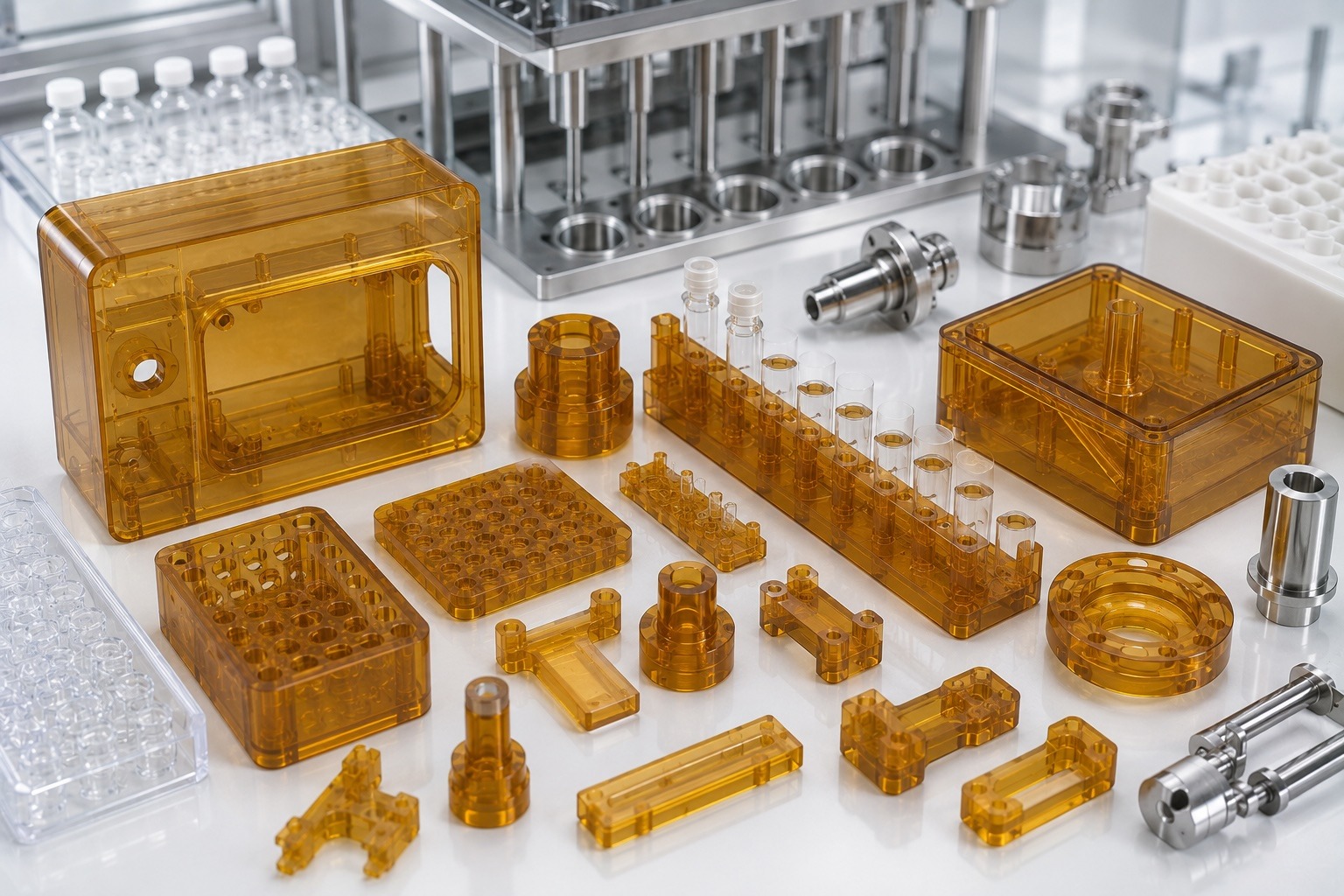
The key is not simply deciding to use ULTEM. The better decision is choosing the right grade, shape, tolerance strategy, and documentation approach for the final environment. For many Modern Plastics customers, ULTEM life sciences components are reviewed alongside materials such as PEEK, PPS, PTFE, acetal, nylon, polycarbonate, stainless steel, or other engineering plastics.
Quick Answer
ULTEM can bridge the gap between commodity engineering plastics and ultra-premium materials in life sciences applications that require sterilization resistance, precision, stiffness, and electrical insulation.
What ULTEM™ PEI Is
ULTEM™ is a family of high-performance amorphous thermoplastics based on polyetherimide, commonly abbreviated as PEI. Depending on the grade, PEI materials may offer a useful combination of high heat resistance, strength, stiffness, dimensional stability, flame resistance, electrical insulation, and machinability.
ULTEM is commonly supplied as stock shapes such as sheet, rod, tube, and film, and it can also be molded, machined, or fabricated into finished and semi-finished components. The exact grade still matters. Unfilled, glass-filled, healthcare-focused, ESD-safe, and specialty grades can perform differently, so the material should be matched to the part geometry, operating environment, and documentation requirements.
Key Properties and Performance Factors
- High heat resistance can help ULTEM maintain useful mechanical performance in elevated-temperature equipment and sterilization-adjacent environments.
- Dimensional stability supports tight-tolerance components, fixtures, housings, and precision assemblies.
- Electrical insulation makes ULTEM useful for connector bodies, sensor housings, insulators, electronic supports, and high-temperature electrical hardware.
- Strength and stiffness allow ULTEM to support structural support roles in properly designed, non-metal-replacement applications.
- Flame retardance and low-smoke performance can be important in aerospace, transportation, electronics, energy, and enclosed industrial environments.
- Machinability allows ULTEM to be fabricated into prototypes, custom components, precision fixtures, insulating parts, and production pieces.
- Chemical and hydrolysis resistance can be valuable, but compatibility must be reviewed carefully by exact grade, chemical, concentration, temperature, and exposure time.
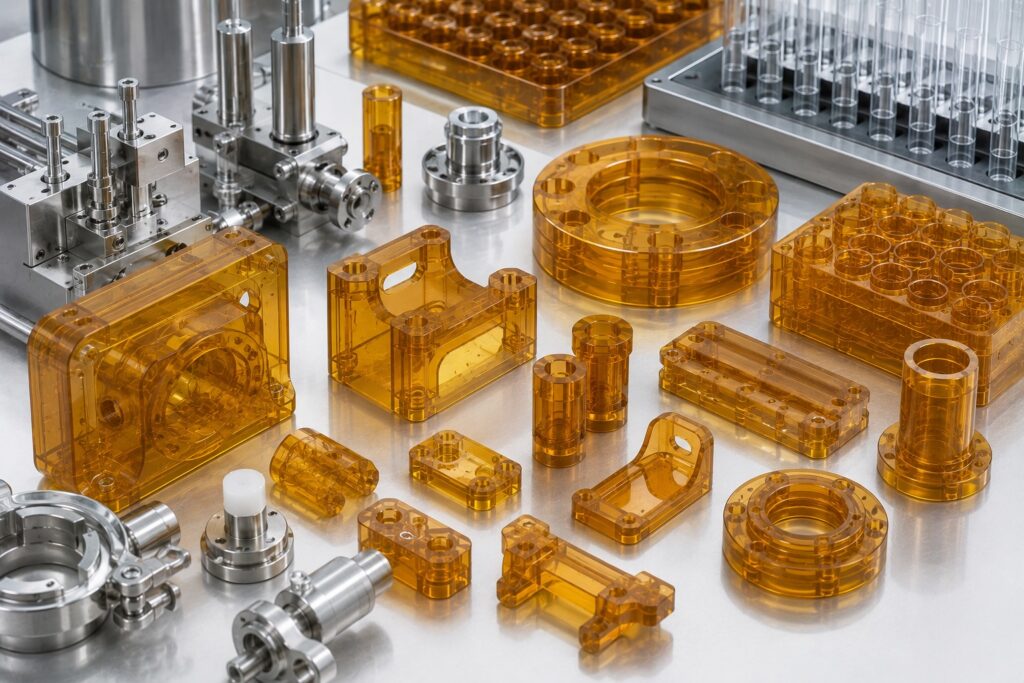
ULTEM can support lab automation and diagnostic equipment when precision and heat resistance are required.
Common Ultem Life Sciences Components Uses
- Bioreactor support hardware, sensor housings, pump components, fluid manifolds, and filter supports
- Robotic lab systems, diagnostic analyzers, precision fixtures, and instrument housings
- PCR equipment, DNA sequencing systems, imaging systems, cartridge housings, and analytical supports
- Sterilization trays, procedure organizers, device housings, and surgical or dental support parts
- Cleanroom assembly fixtures, change parts, packaging components, and validation tooling
The common thread across these applications is that ULTEM often fits where standard plastics may not provide enough temperature resistance, stiffness, electrical insulation, or dimensional control. It is not a universal material, but it can be an effective option when the part requires a higher-performance balance of properties.
Important Selection Considerations for Ultem Life Sciences Components
- Review sterilization method, cleaning chemistry, patient or sample contact, and grade documentation.
- Confirm whether the application is lab support, production tooling, medical device equipment, or fluid-contact hardware.
- Evaluate particle, cleaning, moisture, and temperature requirements in cleanroom or GMP environments.
- Compare ULTEM with PEEK, fluoropolymers, PVDF, stainless steel, and medical silicone when needed.
Engineers and purchasing teams should also consider total cost of ownership. ULTEM is typically more expensive than commodity plastics, so its value is strongest when it helps reduce risk, withstand heat or cleaning cycles, improve part reliability, support electrical performance, or meet demanding manufacturing and documentation expectations.
Comparisons and Alternatives
ULTEM can provide strong performance for sterilizable equipment, laboratory automation, and cleanroom tooling at a more moderate cost than some ultra-premium materials. PEEK, PTFE/PFA, PVDF, stainless steel, or ceramics may be better for extreme chemical exposure, high wear, or long-term implant-related use.
The right alternative depends on what drives the application: heat, wear, chemical exposure, food contact, biocompatibility, traceability, electrical performance, flame requirements, cost, or availability. In many projects, the material selection process is less about choosing the strongest material and more about choosing the most appropriate material for the actual service conditions.
Fabrication, Machining, and Documentation Notes
ULTEM can be machined into precise components, but the design and machining approach still matter. Thin walls, sharp inside corners, aggressive tolerances, unsupported features, or stress-concentrating details can affect part stability and long-term performance. Drawings should identify critical dimensions, holes, slots, chamfers, finish expectations, inspection needs, and any documentation requirements.
For production work, customers should discuss stock shape availability, cut-to-size needs, machining method, part geometry, traceability expectations, material certificates, and grade-specific documentation before ordering. This is especially important for aerospace, medical, semiconductor, pharmaceutical, food, energy, and other documentation-driven environments.
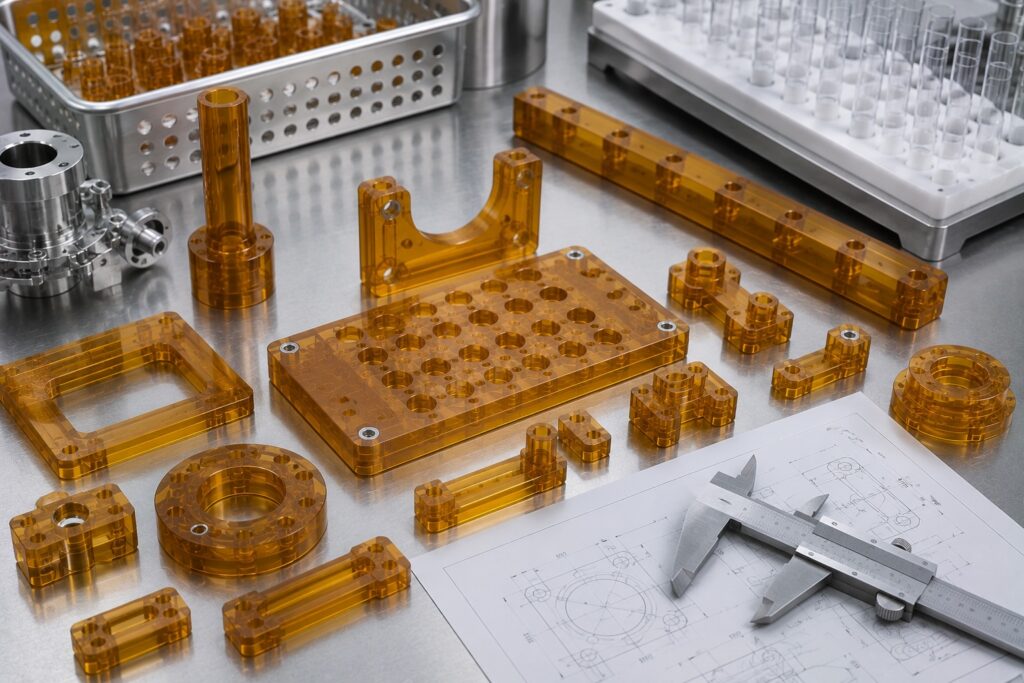
CNC-machined ULTEM fixtures can support cleanroom and bioprocessing workflows when requirements are validated.
Why Modern Plastics
Modern Plastics supports customers with high-performance plastic stock shapes, precision cutting, custom plastic fabrication, machining support, documentation awareness, and practical material-selection guidance. The team works with engineers, OEMs, procurement teams, and fabricators who need reliable materials and support for demanding industrial applications.
When sourcing ULTEM life sciences components, Modern Plastics can help review the application, compare ULTEM with other engineering plastics, discuss stock shape options, support machining or fabrication needs, and help customers think through documentation expectations before production begins.
Is ULTEM the Right Material for This Application?
Ultem Life Sciences Components can be a strong choice when the application calls for heat resistance, dimensional stability, electrical insulation, flame performance, stiffness, and reliable fabrication or machining. It is not the answer for every high-wear, highly aggressive chemical, structural, or cost-sensitive environment, but when the service conditions match the material profile, ULTEM can help support repeatable performance and sourcing confidence.
Frequently Asked Questions
Where is ULTEM used in life sciences applications?
ULTEM is used in bioprocessing support hardware, diagnostic analyzers, lab automation parts, cleanroom tooling, medical electronics, sterilization trays, and analytical equipment.
Why do life sciences OEMs choose ULTEM?
ULTEM offers heat resistance, sterilization durability, dimensional stability, stiffness, electrical insulation, and machinability for precision life sciences equipment.
Can ULTEM be used in bioprocessing systems?
ULTEM may be used in selected support hardware, sensor housings, manifolds, and tooling, but fluid-contact and purity requirements should be verified by grade and process.
Is ULTEM used in 3D printing for life sciences?
Industrial additive manufacturing sometimes uses ULTEM grades for fixtures, tooling, planning models, and validation aids, but the application and validation requirements should be reviewed.
Can Modern Plastics help select ULTEM for life sciences projects?
Modern Plastics can help evaluate stock shapes, machining needs, documentation, and alternatives for ULTEM life sciences components.
Talk to Modern Plastics About Your Application
Whether you need help choosing the right plastic material, comparing performance properties, improving manufacturability, reviewing documentation requirements, or sourcing stock shapes and fabricated components, the Modern Plastics team is ready to help.
0 Comments